
Progressive Tool & Die Stamping
Progressive Tool & Die Stamping Services for Precision Medical Device and High-Tech Components
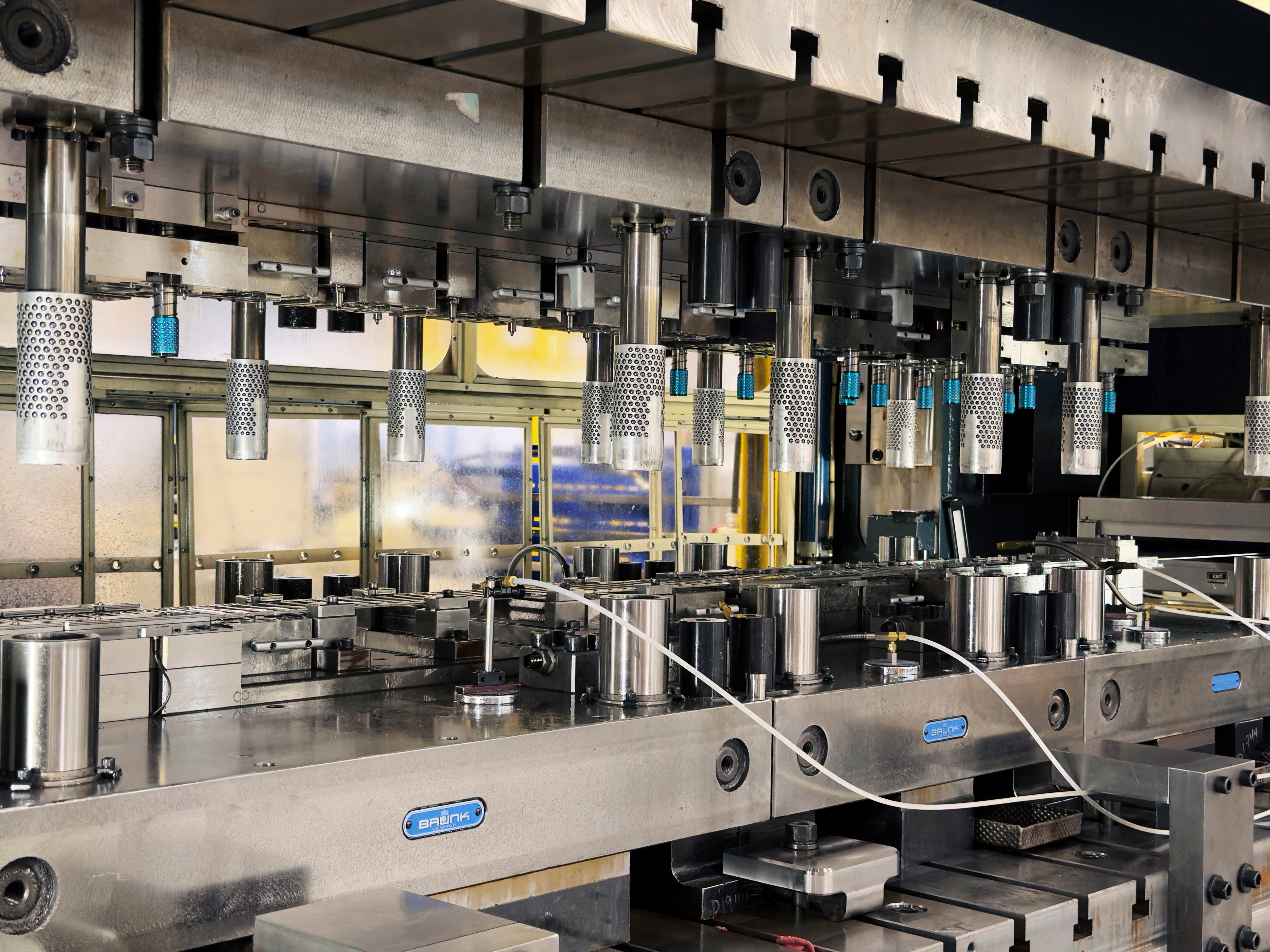
Progressive die stamping is a high-volume metal forming process in which a strip of metal is fed through a series of die stations, each performing a distinct operation on the part geometry until the finished component is produced at the final station and separated from the strip. The progressive die combines blanking, piercing, forming, coining, and other operations into a single tool set that operates at press speed, which allows complex component geometries to be produced at rates that no other metal forming process can approach. At Brunk, progressive stamping is the core production process, supported by an in-house tooling department with over 60 journeyman toolmakers who design, build, and maintain all production tooling.
In-House Tooling Design and Build
Brunk’s tooling department designs and manufactures all progressive dies in-house using SolidWorks CAD and precision tool room equipment. Building tooling internally, rather than sourcing it from outside die shops, gives Brunk direct control over die design decisions that affect part quality, tool life, and process capability. Strip layout, die clearances, pilot placement, stock lifter design, and in-die sensing configurations are all established by Brunk’s toolmakers with knowledge of the press conditions and quality requirements the tool will operate under. When a die requires modification after first-article inspection, those changes are made by the same team that built the tool, which shortens the iteration cycle compared to working through an outside tooling vendor.
Brunk’s press room operates high speed presses combined with both mechanical and servo technology, running in temperature-controlled environments with in-die sensing for monitoring strip progression and detecting tooling anomalies. Press tonnage ranges from 15 to 800 tons and supports both light-gauge foil stampings and heavier-section components, and high-speed press capability supports the production rates required for high-volume medical device and high-tech programs.
Materials and Exotic Alloy Experience
Brunk’s stamping programs regularly involve materials that require specialized process knowledge beyond what is needed for standard carbon or stainless steel stampings. The alloys used in medical device and high-tech applications often have narrow forming windows, significant springback behavior, work hardening characteristics that affect dimensional output across a production run, and surface sensitivity requirements that constrain tooling material and lubricant selection.
Materials Brunk regularly processes in progressive stamping include stainless steel (300 and 400 series), titanium, nitinol, niobium, platinum iridium, beryllium copper, and nickel-based alloys. For each material, die clearances, punch geometry, and press parameters are developed against documented process capability data rather than generalized guidelines. Brunk’s depth of experience with these alloys in high-volume stamping is a direct result of its long history in medical device component manufacturing, where these materials are standard rather than exceptional.
Tolerances and Process Capability
Progressive stamping at Brunk regularly achieves feature tolerances of ±0.001 inches and tighter on critical dimensions, with Cp/Cpk values documented during first-article inspection and monitored through statistical process control in production. The tolerance capability of a given feature is a function of the die design, material properties, press condition, and the dimensional relationship of the feature to the part’s datum structure. Our team designs dies with these relationships explicitly in mind, and the metrology team verifies capability on first-article parts before the program is released to production.
For programs with extremely tight tolerances on formed features, coining operations can be incorporated into the progressive die to improve dimensional consistency by constraining the material’s springback through controlled plastic deformation at the final forming station.
Request a Stamping Program Review
Submit your component drawings to discuss tooling design, material selection, and production volume requirements for precision progressive stamping at Brunk.
Frequently Asked Questions
What is progressive tool and die stamping, and when is it the right manufacturing process?
Progressive tool and die stamping is a high-volume manufacturing process in which metal strip passes through a series of precision stations within a single die set. Each station performs a specific operation—such as piercing, forming, coining, or blanking—until the finished component is produced. It is the ideal solution for precision components requiring high repeatability, tight tolerances, and cost-effective production at medium to high volumes, particularly for MedTech and high-tech applications.
Do you design and manufacture progressive tooling in-house?
Yes. Our tooling engineers design, manufacture, assemble, and maintain progressive stamping dies entirely in-house. This provides complete control over tool quality, process development, and ongoing maintenance while reducing lead times and protecting intellectual property. In-house tooling also enables faster design modifications, continuous process optimisation, and long-term production reliability throughout the life of the program.
What materials can you stamp?
We have extensive experience stamping a wide range of precision metals and high-performance alloys used in medical devices and advanced technology applications. These include stainless steels, titanium, nickel alloys, copper alloys, beryllium copper, phosphor bronze, aluminium, and other specialist materials. Material selection is based on the mechanical, electrical, corrosion resistance, and regulatory requirements of each application.
What tolerances can you achieve with progressive stamping?
The achievable tolerance depends on component geometry, material type, thickness, and tooling design. Through precision toolmaking, robust process control, and advanced inspection methods, we consistently manufacture components with tight dimensional tolerances and excellent repeatability. During project development, we work closely with customers to establish manufacturable tolerances that balance performance, quality, and production efficiency.
How do you ensure consistent quality throughout production?
Quality is built into every stage of the manufacturing process. Progressive stamping operations are supported by validated tooling, in-process inspection, statistical process control where appropriate, and precision metrology. Tool maintenance programs and continuous process monitoring help ensure long-term dimensional stability, while comprehensive traceability supports the quality requirements of regulated MedTech and high-reliability industrial applications.
Can progressive stamping be integrated with secondary manufacturing operations?
Yes. Progressive stamping is often one stage within a complete manufacturing solution. Depending on the application, stamped components can be seamlessly integrated with laser cutting, CNC machining, precision grinding, welding, heat treatment, surface finishing, cleaning, automation, and final assembly. By managing these processes within a single manufacturing environment, we reduce handling, improve quality, shorten lead times, and provide customers with a complete, production-ready component.
What is the standard leadtime for a progressive stamping tool?
There is no "one-size-fits-all" answer to such a question as Brunk deals with projects of varying complexity, but given our tooling in produced inhouse with our dedicated tool makers we are in control of the project delivery through it lifecycle. By rule of thumb, for less complex components our leadtime can be as short as 12 weeks.