Automated Solutions
Custom Automated Assembly for Precision Manufacturing
Automation is an integral part of our manufacturing capability, enabling consistent quality, improved process control, and efficient production across a wide range of medical device and high-technology applications. Our automation team designs, develops, and integrates custom manufacturing systems tailored to the technical, quality, and production requirements of each program.
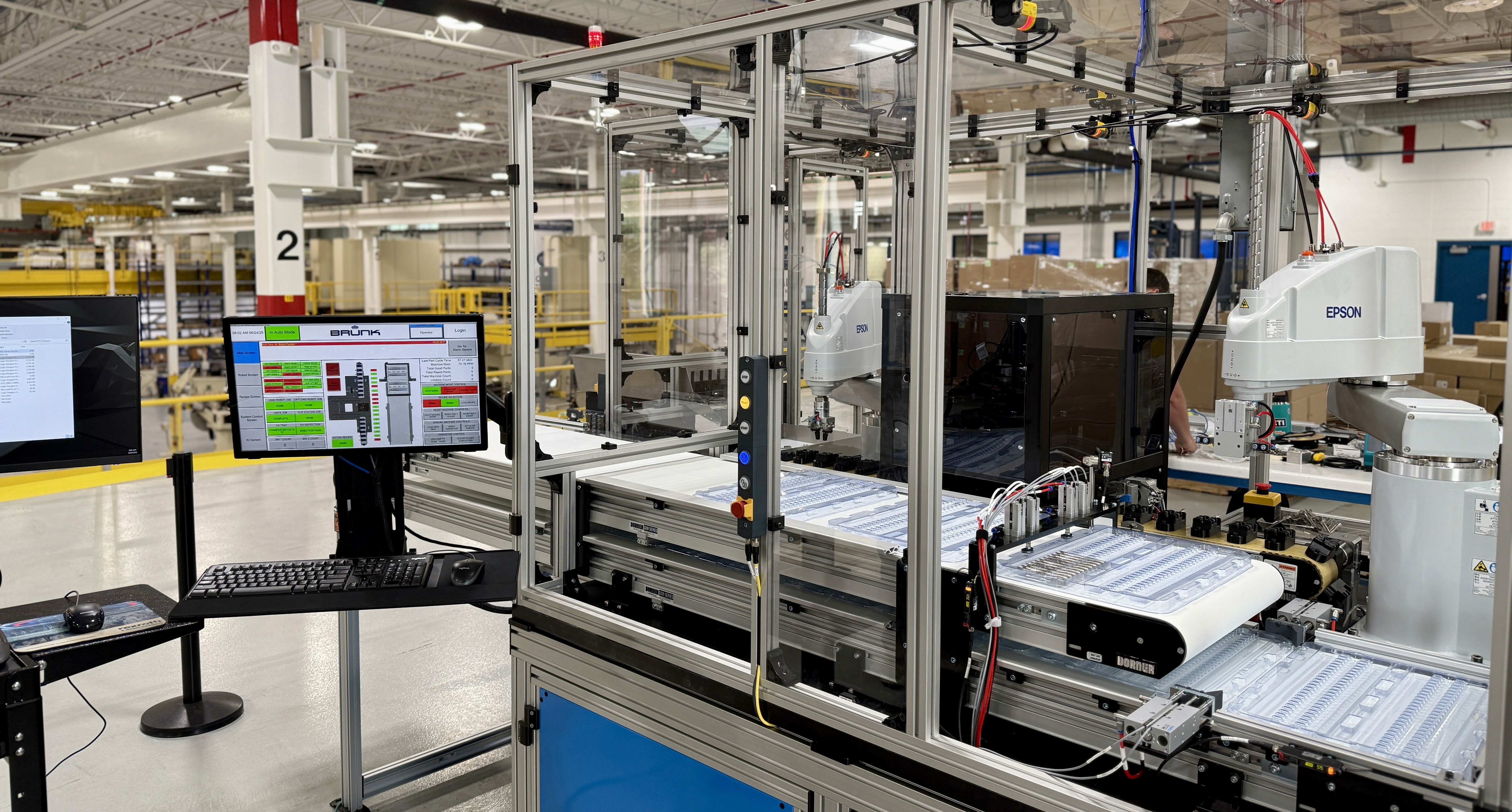
From dedicated workstations to fully integrated production cells, we deliver both semi-automated and fully automated solutions that combine robotic handling, precision fixturing, machine vision, in-line inspection, and process monitoring. Systems are developed to suit the specific manufacturing process, product complexity, and production volume, ensuring the appropriate level of automation for each application.
Our engineers have experience integrating a broad range of industrial robotic platforms and automation technologies, selecting the most suitable equipment based on the technical requirements of the project rather than a single equipment supplier.
Integrated Manufacturing Automation
Automation is developed as part of the overall manufacturing process, not as an isolated operation. Our systems integrate seamlessly with upstream processes including precision moulding, metal stamping, CNC machining, laser welding, surface finishing, and other secondary operations to create efficient, controlled production workflows.
Where appropriate, multiple manufacturing and joining processes can be combined within a single automated cell, reducing manual handling, minimizing work-in-progress, improving positional accuracy, and increasing overall process robustness. This integrated approach shortens production cycles while maintaining the high levels of repeatability required for precision components.
Process Verification and Quality Control
Quality assurance is embedded within every automated system. Machine vision, dimensional verification, presence detection, force monitoring, and other in-process inspection technologies are incorporated at critical stages to verify product quality before each component progresses through the manufacturing sequence.
Process data can be captured and monitored in real time, providing continuous verification of critical process parameters and enabling rapid identification of any deviations from validated operating conditions. Automated reject handling and process monitoring help maintain consistent production quality while reducing the risk of non-conforming product advancing through the manufacturing process.
Automation systems are designed to support the documentation and traceability requirements of regulated manufacturing environments. Production data, inspection results, process parameters, and material traceability can be integrated with quality management systems to provide comprehensive manufacturing records and support validation activities.
For medical device applications, automated systems can be configured to meet the documentation and process control requirements associated with ISO 13485 and other customer-specific quality standards, providing the traceability and audit trail necessary throughout the product lifecycle.
Discuss Automated Assembly for Your Program
Contact Brunk’s engineering team to review component geometry, joining requirements, and production volume targets for automated assembly integration
Frequently Asked Questions
Can you design and build custom automation equipment for our production line?
Yes. In addition to supporting our own manufacturing, we work with customers as an automation integration partner. We can develop bespoke automation equipment for new production lines, upgrade existing manufacturing processes, or integrate robotics, vision systems, inspection technologies, and material handling into customer facilities. Systems can be supplied as standalone workstations or as fully integrated production cells.
How do you ensure automated systems deliver consistent quality?
Quality is designed into every automation solution. Systems can incorporate machine vision, force monitoring, dimensional verification, barcode or serialisation, process data collection, and automated inspection to verify critical product characteristics throughout the manufacturing cycle. Where required, automation can also support validated manufacturing processes and comprehensive production traceability, helping customers meet the quality and regulatory requirements expected in MedTech and other high-reliability industries.
Can you build and validate automation systems for regulated industries?
Yes. Our automation systems are developed with validation and regulatory compliance in mind. For customers in the MedTech sector, we can support equipment qualification activities and provide the documentation required to facilitate validation. Systems are designed using a risk-based approach, with appropriate process controls, traceability, and documentation to support installation, operational, and performance qualification (IQ/OQ/PQ) where required.
Do you perform Factory Acceptance Testing (FAT) and Site Acceptance Testing (SAT)?
Yes. We work with customers to develop comprehensive Factory Acceptance Test (FAT) and Site Acceptance Test (SAT) protocols that verify equipment performance against agreed user and functional requirements. FAT is carried out before shipment to confirm that the system operates as intended under controlled conditions, while SAT verifies correct installation, integration, and performance following commissioning at the customer's facility. These activities help minimise commissioning risk and support a smooth transition into production.
Can you integrate automation into an existing production line?
Yes. In addition to supplying complete standalone automation systems, we can integrate new automation into existing manufacturing environments. Whether upgrading a manual process, increasing production capacity, or introducing robotics, machine vision, or automated inspection, our engineering team works closely with customers to ensure seamless integration while minimising disruption to ongoing production.