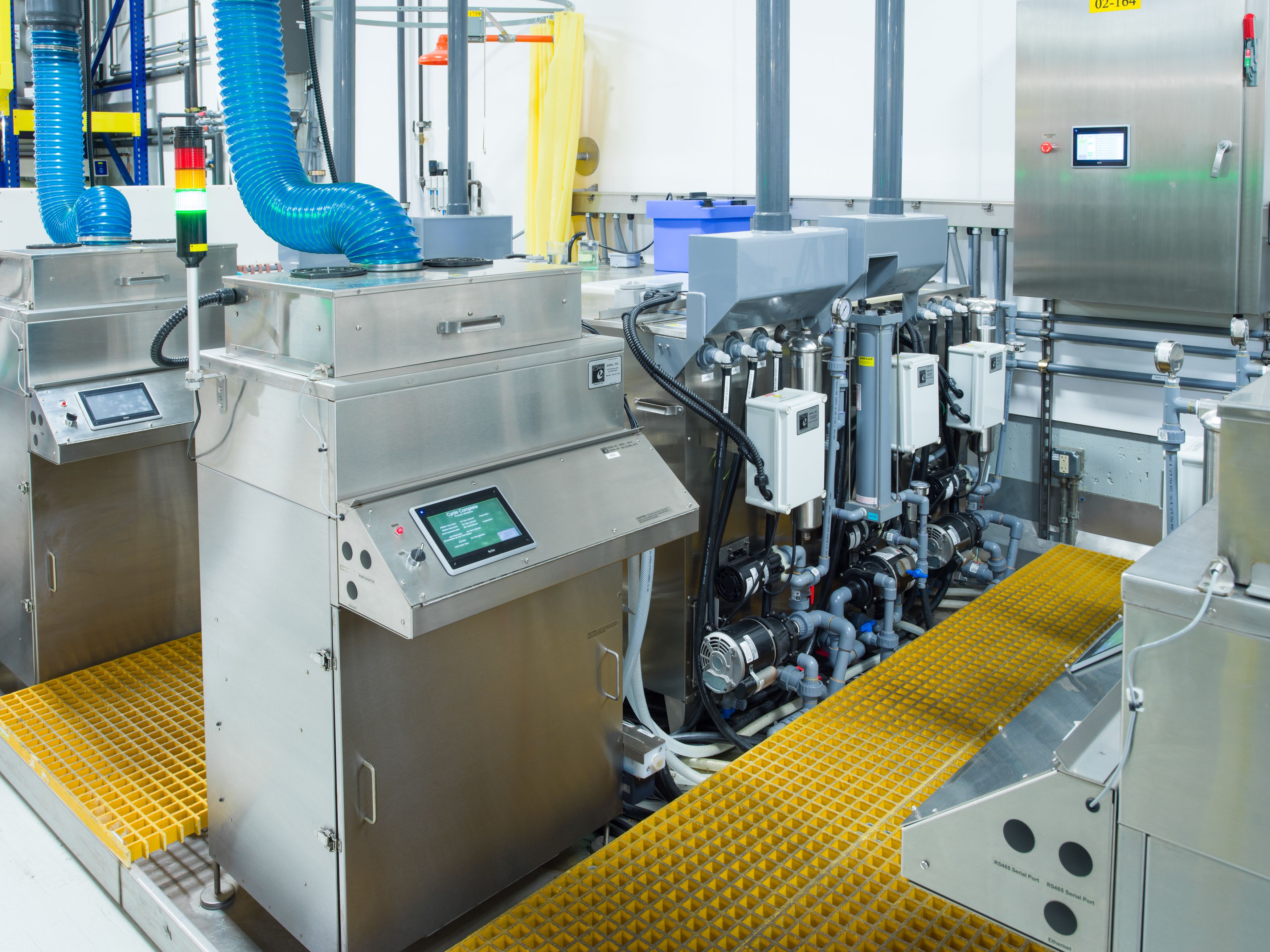

Surface Finishing
Surface Finishing for Precision Stamped and Machined Metal Components
Surface finishing refers to the processes applied to a metal component after forming or machining to modify its surface condition, corrosion resistance, electrical properties, or appearance. For precision metal components in medical device and high-tech applications, surface finishing is often a functional requirement rather than a cosmetic one. The surface condition of an implantable component affects its biocompatibility and corrosion performance in the body. The surface condition of an electrical contact affects its conductivity and reliability over the component’s service life. Treating surface finishing as an afterthought rather than an integrated part of the production process introduces variation that can be difficult to detect and costly to correct.
At Brunk, surface finishing operations are performed in-house and are treated as process steps within the production quality plan, not as secondary operations managed by an outside vendor. This means surface finishing parameters are documented, controlled, and traceable to the same program record as the forming and machining operations that precede them.
Surface Finishing Processes at Brunk
Electropolishing
Electropolishing is an electrochemical process that removes a controlled layer of material from the surface of a metal component, preferentially dissolving surface asperities and producing a smoother, more uniform surface profile. For stainless steel components used in medical devices, electropolishing improves corrosion resistance by creating a chromium-enriched passive layer and removes embedded contaminants from mechanical processing. It also produces a surface that is easier to clean and less prone to bacterial adhesion, which is relevant for components used in surgical and implantable applications. Electropolished surfaces are typically characterized by Ra surface roughness measurements, and Brunk documents pre- and post-process measurements as part of the inspection record.
Passivation
Passivation is a chemical treatment applied to stainless steel and other corrosion-resistant alloys to remove free iron and other surface contaminants introduced during machining or forming, and to promote the formation of a stable chromium oxide passive layer. The process is performed per ASTM A967 or ASTM A380 depending on the alloy and application requirements. For medical device components, passivation is commonly required as a post-processing step to ensure the component meets corrosion resistance requirements under ISO 10993 and similar standards. Brunk performs passivation in-house with documented process parameters and verifies results through testing methods including copper sulfate testing and high humidity testing per applicable standards. uniformity. Thickness is verified by X-ray fluorescence measurement, and results are documented to the program record.
Plating and Coating
Brunk performs selective plating operations including gold plating and nickel plating for components where surface conductivity, contact resistance, or wear resistance are functional requirements. Gold plating is applied to electrical contact surfaces where low and stable contact resistance is required over the component’s service life. Nickel plating is used for corrosion protection and as an underlayer for gold where diffusion barrier properties are needed. Plating operations are controlled by bath chemistry, current density, and plating time parameters that determine deposit thickness and uniformity. Thickness is verified by X-ray fluorescence measurement, and results are documented to the program record.
Surface Finishing for Regulated Programs
For programs operating under ISO 13485, surface finishing processes must be validated and maintained under controlled conditions. At Brunk, surface finishing procedures are documented as controlled work instructions, process parameters are monitored and recorded for each production run, and any deviation from the defined process triggers a nonconformance review before affected parts are released. Material compatibility between the substrate alloy and the finishing chemistry is verified during process development, and test coupons are used to confirm process output before production parts are processed.
Discuss Surface Finishing Requirements
Contact Brunk’s engineering team to discuss electropolishing, passivation, plating, or coating requirements for your precision metal components.
Frequently Asked Questions
Why is surface finishing important for precision medical and high-tech components?
Surface finishing plays a critical role in the performance, reliability, and longevity of precision components. For MedTech and high-tech applications, finishing processes can improve corrosion resistance, reduce surface contaminants, enhance wear resistance, improve electrical performance, and create the surface characteristics required for the final application. At Brunk, surface finishing is used to optimise the performance of precision stamped and machined components while maintaining the dimensional requirements of the finished part.
What surface finishing processes does Brunk provide?
Brunk supports a range of surface finishing processes to meet the functional and regulatory requirements of each application. These include electropolishing, passivation, plating, and coating processes. The appropriate finish is selected based on factors such as material type, component geometry, environmental exposure, biocompatibility requirements, electrical properties, and customer specifications.
What is the difference between electropolishing and passivation?
Electropolishing and passivation are both commonly used for stainless steel medical device components, but they serve different purposes. Passivation removes free iron and surface contaminants to improve the natural corrosion resistance of stainless steel. Electropolishing is an electrochemical process that removes a controlled amount of surface material to improve smoothness, reduce microscopic imperfections, enhance cleanability, and further improve corrosion resistance. The choice of process depends on the performance requirements of the application.
Can Brunk manage surface finishing for regulated medical device programs?
Yes. Brunk supports surface finishing requirements for regulated MedTech applications through controlled processes, qualified suppliers, and documented quality procedures. Surface finishing processes are managed with consideration for material traceability, process validation, inspection requirements, and customer-specific specifications. This approach supports the quality and documentation expectations required for medical device manufacturing.
Can surface finishing be integrated with Brunk’s stamping and machining capabilities?
Yes. Surface finishing is an important part of Brunk’s integrated manufacturing approach. By combining precision metal stamping, tooling, machining, laser processing, welding, and finishing capabilities, Brunk can provide a complete manufacturing solution from raw material through finished component. Managing these processes within a coordinated supply chain helps reduce handling, maintain consistency, and improve overall program efficiency.
How does Brunk ensure consistent surface finish quality?
Consistent surface finishing begins with selecting the correct process for the material and application, followed by controlled processing and inspection. Brunk works with qualified finishing partners and applies appropriate quality controls to verify requirements such as appearance, corrosion resistance, surface condition, dimensional impact, and compliance with customer specifications. Documentation and traceability are maintained to support high-reliability MedTech and high-tech manufacturing programs.